
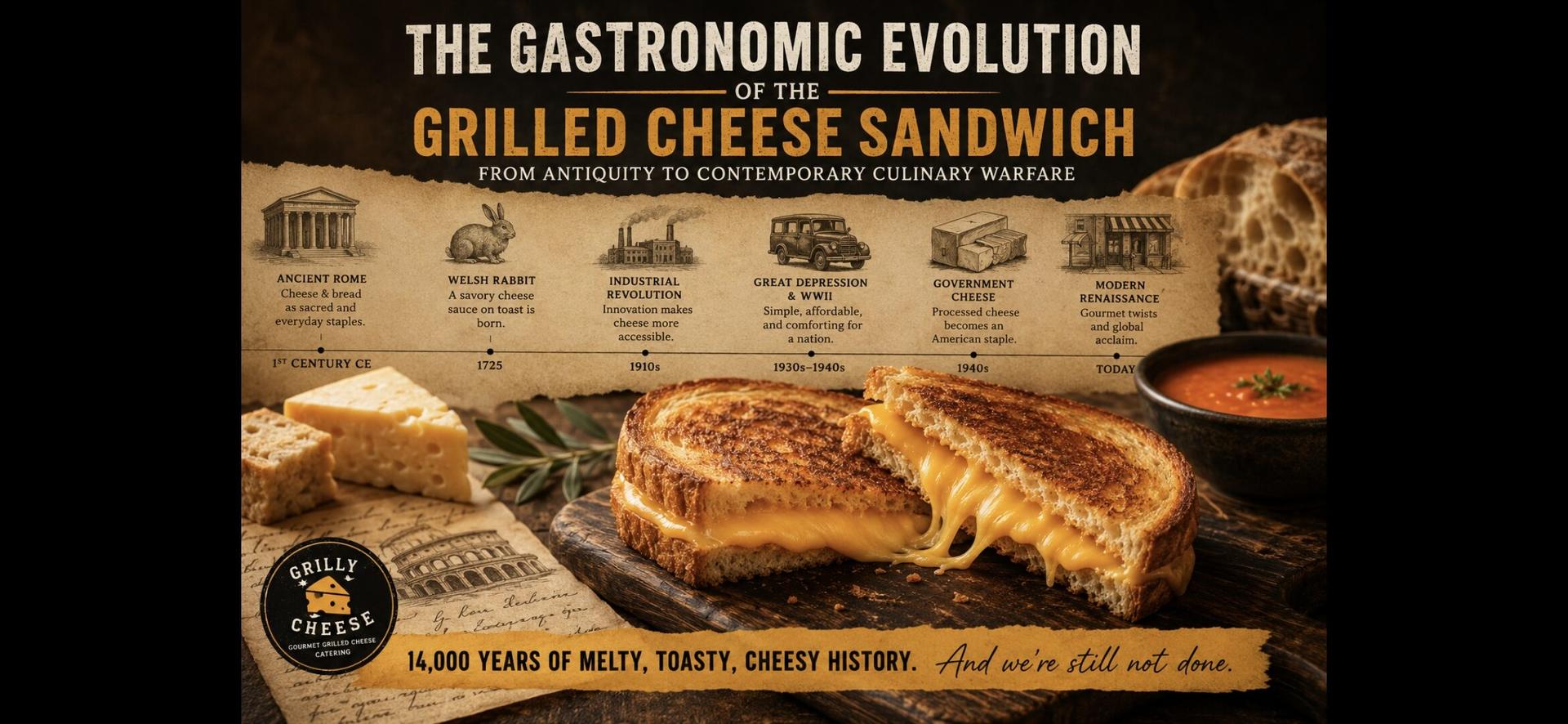
The history of the grilled cheese sandwich is, in the grandest sense, the history of human civilization — or at least the most delicious parts of it. Every era that figured out how to apply heat to bread and cheese was, in our professional opinion, doing something right. Today's gourmet grilled cheese catering scene — the kind we serve across Philadelphia and New Jersey — owes a debt to thousands of years of cheese-melting ambition. This is that story. We've tried to keep it accurate. We've also tried to keep it entertaining. The two goals were occasionally in conflict.
At Grilly Cheese, the history of this sandwich isn't just trivia — it's the backbone of what we do. Understanding how the modern grilled cheese sandwich became the cultural icon it is today explains why it works so well as food truck catering for thousands of different events. It's universally loved. It's customizable. And it's genuinely old — much older than you think.
I. The Ancient Foundations: Cheese, Bread, and Heat
Humans have been eating cheese since approximately 8,000 BCE, which is when our ancestors apparently decided that leaving milk sitting around long enough was a good idea. They were right, of course — the evidence is compelling and delicious. Bread, for its part, has been with us since at least 14,000 BCE, based on charred flatbread remains found in Jordan. So in the long view of history, the only question was: how long would it take someone to put these two things together near a fire?
The answer, roughly, is "not long." Ancient Roman cookbooks — specifically the first-century CE text Apicius — describe dishes in which bread was layered with cheese and subjected to heat. The Romans called something like this aliter dulcia, a warm cheese preparation served on bread. They may not have called it a grilled cheese, but they were clearly on the right track. Roman legionnaires spread this tradition across Europe with the same enthusiasm they spread everything else — roads, aqueducts, and aggressive expansion policy included.
The key ingredient they were working with — melted cheese on bread — is so fundamental that it barely needs explaining. Cheese melts. Bread toasts. The combination of textures — yielding interior, golden crust — creates a sensory experience that, it turns out, is hardwired into human preference. Food scientists have actual explanations for this involving the Maillard reaction and glutamate receptors. We prefer the simpler explanation: it's incredible.
Medieval Europe continued the tradition, refining artisanal cheese techniques through monastery systems that preserved and advanced cheesemaking as secular institutions collapsed and reorganized around them. By the 1200s and 1300s, cheese on toasted bread was a documented staple food across England, France, and the Italian peninsula — prepared by everyone from monastery kitchens serving pilgrims to traveling vendors at market fairs.
Historical note on "toasted cheese"
Medieval English sources distinguish between "green cheese" (fresh, unaged) and "hard cheese" (aged) when describing toasted preparations. The melting behavior of aged cheese on toasted bread was considered something of a cooking milestone — one medieval cookbook entry describes pressing the cheese against a hot stone "until it runnes" which is, honestly, a perfect instruction even today.
II. The Welsh Rabbit: A Cheese Sauce Gets a Name (and a Complicated Explanation)
In 1725, something remarkable happened in the written culinary record: the first documented reference to "Welsh Rabbit" appeared. This was a savory preparation of cheese — typically a sharp, aged cheddar — melted with ale, mustard, and Worcestershire sauce into a thick, pourable sauce, then ladled over toasted bread. It was rich. It was salty. It was British pub culture refined into something extraordinary.
The name is itself a piece of dry English humor. Welsh Rabbit contained no rabbit whatsoever. The joke, such as it was, operated on the premise that the Welsh were too poor to afford actual meat, and therefore their "rabbit" was cheese. This was ethnic condescension packaged as wit, and the English have been explaining it with decreasing enthusiasm ever since. Later, in an apparent attempt to make the dish sound more respectable, someone renamed it "Welsh Rarebit," which at least sounds intentional.
What Welsh Rabbit represents in the history of the grilled cheese sandwich is the formalization of cheese-on-toast as a distinct culinary category — something worth naming, worth ordering, worth writing down. Today's gourmet grilled cheese menu draws a direct line from this tradition: the combination of great cheese, controlled heat, and thoughtful additions (our menus feature everything from smoked bacon to fig jam alongside the cheese) is exactly the same principle at scale. If you want to experience the private event catering version of what the Welsh were onto in 1725, we're available for booking.
III. The Croque-Monsieur: France Elevates the Form
France, having watched England develop a melted cheese dish and name it after a Welsh joke, decided to do better. In the early 1900s, the croque-monsieur appeared in Parisian cafes — a pressed, hot sandwich of jambon (ham) and Gruyère on pain de mie (white sandwich bread), finished with béchamel sauce. Its name translates roughly to "mister crunch," which is considerably more dignified than Welsh Rabbit.
The croque-monsieur is important for two reasons. First, it established the principle that a cheese sandwich could be sophisticated — something ordered in a fashionable café alongside an espresso rather than eaten out of necessity at a market stall. Second, it introduced the idea that cheese and bread could include protein (in this case, ham) without losing the essential identity of a cheese-forward dish. This is the conceptual foundation for what we now call a "melt" — and it's the same framework that allows our menu of grilled cheese sandwiches to include proteins without abandoning grilled cheese identity.
The croque-madame, a variation with a fried egg on top, appeared shortly after and immediately became the subject of the most civilized brunch argument in history. Grilled cheese historians — yes, this is a thing — date both preparations to the first decade of the twentieth century. By 1910, the Parisian café scene had fully embraced elevated comfort food as a category, and the croque-monsieur was its flagship. This cultural shift — comfort food as something worth serving with pride — is directly relevant to why wedding catering now regularly features gourmet grilled cheese as a reception option rather than a quirk.
IV. The French Connection: Elevated Comfort Food Goes Global
The influence of French cuisine on the broader trajectory of cheese-on-bread is difficult to overstate. The French treated cheese as a serious subject — something requiring terroir, classification, regional specificity — at a time when most of the rest of the world was treating it as a functional food preservation technology. This cultural authority meant that when French-influenced cooking spread through the early twentieth century restaurant scene, it brought with it a respect for dairy craftsmanship that elevated everything it touched.
The Parisian café model — where a simple, honest cheese sandwich could be presented as something worth savoring rather than merely consuming — gave cultural permission for the modern gourmet grilled cheese to exist. When you book corporate event catering with a gourmet grilled cheese food truck today, you're the beneficiary of a very long chain of French culinary snobbery doing unexpected good in the world.
A note worth adding here: France also gave us fondue, raclette, and a dozen other preparations in which the entire point is melting cheese in interesting ways. The country has a clearly documented commitment to this research area. We respect this commitment and believe it deserves more credit in the history of comfort food as a culinary category. For our take on the best cheese choices for grilled cheese, French cheese traditions figure prominently.
V. The Industrial Revolution: Processed Cheese and the Democratization of the Melt
The Industrial Revolution changed everything about food production, and it changed nothing more dramatically than cheese. In 1911, Swiss chemist Walter Gerber discovered that adding sodium citrate to melted cheese created a stable, smooth, re-meltable product that could be manufactured at scale, stored for months, and shipped across vast distances without spoiling. In 1916, James L. Kraft — yes, that Kraft — patented a process for pasteurized processed cheese and immediately began selling it to the U.S. Army.
This development is controversial in cheese circles, as you might imagine. Traditional cheesemakers viewed processed cheese with approximately the same enthusiasm that wine experts have for boxed wine. But processed cheese did something that artisanal cheese simply could not do: it made cheese accessible to everyone, at any time, at a price that working-class families could afford. And it melted magnificently. Perfectly. Every time.
For the history of the grilled cheese, this is the pivotal moment. The combination of processed American cheese, which melts with no effort, and industrially sliced white bread, which toasted consistently, meant that anyone could make a perfect grilled cheese on a stovetop with two minutes and a pat of butter. The barrier to entry collapsed. A comfort food that had previously required some skill and decent-quality ingredients became something a child could make. And millions of children — and adults, and short-order cooks, and army mess halls — immediately did exactly that.
For what it's worth, we use a blend of cheeses — including American for its legendary melt properties, alongside sharp cheddar and other aged varieties for complexity. The Industrial Revolution was right about the melt. The artisan cheesemakers were right about the flavor. The correct answer turned out to be both.
VI. The Great Depression and World War II: When Grilled Cheese Fed a Nation
The 1930s and 1940s are when the grilled cheese sandwich became a genuinely American institution. During the Great Depression, the U.S. government's New Deal food programs distributed processed cheese and white bread as staple rations. Cooks across the country responded by making what they could: open-faced "cheese dreams" — a slice of bread topped with processed cheese and broiled under a flame — which appeared on diner menus and in home kitchens from coast to coast as affordable, filling, and nutritionally respectable working-class comfort food.
In New Jersey and Philadelphia, the Depression-era diner culture established grilled cheese (and its companion, tomato soup) as the quintessential American lunch combination. Diners from Camden to Cherry Hill served it for pennies. It fed construction workers, factory hands, and schoolchildren. The cultural association between grilled cheese and unpretentious, honest, deeply satisfying food was cemented in this era — an association that the food truck catering culture across New Jersey today both respects and playfully elevates.
World War II extended this pattern: the U.S. Army served millions of grilled cheese sandwiches (and cheese dreams) to servicemen through commissary operations. Navy cooks pressed them in panini irons. Army mess halls served them alongside tomato soup by the industrial vat — which is, if you think about it, the original high-volume catering operation. The military requirement for food that could be prepared quickly for hundreds of people, was nutritious, was universally palatable, and cost almost nothing — this is essentially the design brief for a great food truck menu.
By the end of the 1940s, grilled cheese had served its country. It had fed the unemployed, fueled soldiers, and comforted a nation through fifteen years of consecutive catastrophe. It deserved a rest. Instead, it got a late-night reinvention.
VII. Government Cheese: An Unlikely American Staple
In the late 1970s and early 1980s, the U.S. government found itself holding approximately 2 billion pounds of surplus cheese. This was not an accident. Federal dairy price supports had created a market incentive for dairy farmers to produce as much milk as possible, and the resulting cheese stockpile — stored in 150 caves and warehouses across the country — had become a fiscal and logistical crisis. The Reagan administration's solution was to distribute it directly to low-income Americans, beginning in 1981.
"Government cheese," as it came to be known, was a five-pound block of processed American cheese distributed to recipients in commodity food programs. It was not gourmet. It was not subtle. But it melted like a dream, it was genuinely filling, and for millions of American families, it was a dietary staple through the early 1980s. The grilled cheese sandwiches made from government cheese — on white bread, in a cast-iron pan with whatever fat was available — were, by all accounts, extremely good.
The government cheese era cemented grilled cheese's identity as a democratic food — something eaten and loved across every class, every region, every age group. Today, that democratic identity is exactly why grilled cheese works so well at festivals and community events. It requires no explanation, no cultural initiation, no acquired taste. Everyone already loves it. Every demographic at your event catering experience arrives pre-convinced. Grilled cheese became an American gathering staple — from block parties and school fairs to corporate picnics and wedding receptions — because of exactly this history.
VIII. Extremes of the Form: World Records, Pop Culture, and Haute Cuisine
By the 1990s and 2000s, grilled cheese had become something of a cultural obsession — not in the diner sense, but in the enthusiast sense. Food writers began treating it seriously. Restaurants began offering elevated versions. And then, inevitably, people began trying to build the world's largest one.
The world's largest grilled cheese record has changed hands multiple times. As of the most recent verifiable attempts, it has involved sandwiches weighing hundreds of pounds, requiring industrial-scale flat-top griddles, and drawing crowds of hundreds. The spirit of these attempts — the communal spectacle, the shared experience of watching something absurd happen with food — is not entirely separate from what makes food truck wedding catering so effective as an event centerpiece. There is something inherently social and theatrical about grilled cheese made at scale.
The pop culture footprint of grilled cheese expanded dramatically in this era. It appeared in films as shorthand for comfort, home, and nostalgia. The Food Network ran episodes devoted to it. High-end restaurant chefs began offering $25 grilled cheese sandwiches featuring truffle butter and aged Gruyère — which provoked an entirely reasonable amount of outrage and an entirely unreasonable amount of consumption. The sandwich that had fed Depression-era families on pennies was now appearing on tasting menus.
At the same time, the food truck revolution of the late 2000s and early 2010s found the festival food truck format perfectly suited to gourmet grilled cheese. The combination of an interactive cooking experience — watching the sandwich press on the flat-top, hearing the sizzle, seeing the cheese pull — with the primal comfort of the food itself made it a natural hit at outdoor festivals, farmers markets, and community events. Interactive food experiences at events create exactly this kind of engagement — and grilled cheese, cooked live in front of you, is the original interactive food experience.
IX. The Melt vs. the Grilled Cheese: A Distinction That Matters
A brief but important detour into taxonomy: what exactly is the difference between a grilled cheese and a melt?
The generally accepted distinction is this: a grilled cheese contains only cheese between the bread. A melt contains cheese plus protein — typically tuna, chicken, turkey, or beef — making it the spiritual descendant of the croque-monsieur. In practice, the line blurs constantly. A sandwich with caramelized onions and Gruyère — no protein — still feels more like a sophisticated preparation than a simple grilled cheese, even though technically it qualifies.
Our own menu of sandwiches lives deliberately in this liminal territory. The Cluck Norris — grilled chicken, sharp cheddar, and roasted garlic aioli — is technically a melt. The Classic Grilly — three-cheese blend on sourdough — is unambiguously a grilled cheese. Both are excellent. Both share the essential DNA of everything described above: heat, cheese, bread, and the conviction that simplicity, done perfectly, is indistinguishable from sophistication.
X. The Jersey City Case Study: How a Food Truck Scene Reinvented a Classic
Jersey City deserves specific mention in the modern history of gourmet grilled cheese, because what happened there in the early 2010s is a microcosm of the national food truck revolution. The combination of a dense, diverse, food-literate population; proximity to New York City food culture; and relatively affordable food truck permitting created a perfect environment for culinary experimentation on wheels.
The gourmet grilled cheese truck format — which took an accessible, universally beloved comfort food and applied chef-level technique, premium ingredients, and creative combinations — found an immediate audience in Jersey City's lunch crowds, weekend markets, and event circuit. It spread from there across Hudson County, Bergen County, and eventually the full metropolitan area.
Today, gourmet grilled cheese culture continues thriving across the Philadelphia and New Jersey catering scene. From South Jersey catering events in Camden and Burlington counties to Philadelphia corporate lunches along the Market Street corridor, the gourmet grilled cheese food truck has become a fixture at events of every type. Food truck catering across New Jersey has matured from a novelty into a professional catering industry — one that takes the humble cheese sandwich seriously enough to have developed proprietary cheese blends, custom bread partnerships, and event logistics operations that would impress a military mess coordinator.
On the subject of tomato soup
No history of grilled cheese is complete without acknowledging tomato soup. The pairing became culturally universal during the Depression and WWII era, when Campbell's condensed tomato soup and processed cheese sandwiches were both abundant and affordable. The acidity of the tomato cuts the richness of the cheese; the warmth of the soup complements the warmth of the sandwich. Neurologically, the combination hits almost every comfort food receptor simultaneously. It is not an accident that this pairing has survived for nearly a century. At our events, we occasionally reference this pairing in our menu context — it is, in our view, one of the most historically validated food pairings in American culinary history.
Conclusion: 14,000 Years and Still Going
The grilled cheese sandwich has survived ancient Rome, medieval monastery kitchens, 18th-century English pub culture, French culinary sophistication, the Industrial Revolution, two World Wars, government cheese distribution programs, the food truck revolution, and at least one attempt to sell it for $25 with truffle oil. It has emerged from each of these encounters not just intact but improved — refined by each era's particular obsessions, constraints, and creativity.
What makes it endure isn't nostalgia, exactly — though nostalgia certainly helps. It's the underlying simplicity of the idea: bread, cheese, heat. Three things. The technique is the variable. The quality of the ingredients is the variable. The context — whether you're serving Roman legionnaires, Depression-era families, or guests at a wedding reception — is the variable. The core remains constant.
At Grilly Cheese, we think about this history every time we fire up the flat-top. We're not just serving sandwiches. We're participating in a 2,000-year tradition of making people very happy with bread and cheese. It's a tradition worth respecting — and occasionally, worth ordering for corporate events, wedding catering, and any other occasion when you want to feed people something genuinely excellent.
Frequently Asked Questions
When was the grilled cheese sandwich invented?
The modern grilled cheese emerged in the 1920s United States when sliced bread and processed American cheese became widely available. Ancient civilizations ate bread with cheese, but the mass-produced version took hold during the Great Depression era.
What is Welsh Rabbit and how does it relate to grilled cheese?
Welsh Rabbit (or Welsh Rarebit) is an 18th-century British dish of melted cheese sauce served over toast. It is considered a historical ancestor of the grilled cheese sandwich, popularizing the combination of cheese and bread.
Why was grilled cheese popular during the Great Depression?
Grilled cheese was cheap and filling. The U.S. government distributed American cheese to families in need, and combining it with affordable bread created a satisfying meal — cementing grilled cheese as the definitive American comfort food.
How did food trucks change grilled cheese culture?
The American food truck boom of the late 2000s elevated grilled cheese from a diner staple to gourmet street food. Trucks began using artisan breads, aged and specialty cheeses, and creative fillings, introducing the sandwich to a new generation.
Ready to Continue the Tradition?
We bring gourmet grilled cheese catering to events across Philadelphia, New Jersey, and the greater Mid-Atlantic region. Whether you're planning a corporate lunch, a wedding reception, or a private party, we'd love to be part of your event's story.